New York City Ballet is currently presenting a Digital Spring Season, twice a week making certain performances available to view for 72 hours: https://www.nycballet.com. So far, they’ve shown George Balanchine’s Allegro Brilliante, Justin Peck’s most recent work, Rotunda, and most recently Balanchine’s Apollo, one of my all-time favorite ballets.
Created in 1928 for Serge Diaghilev’s Ballet Russes, when Balanchine was a mere 24 years old, Apollo is a short ballet to music by Igor Stravinsky. Stravinsky had been commissioned by the Library of Congress in 1927 to write the ballet for a festival in April 1928; the requirements included only six dancers, a small orchestra, and no more than 30 minutes, but the choice of subject was left to him. Stravinsky decided to make Apollo the central figure, and devised a scenario involving the birth of Apollo, his interactions with three Muses – Calliope, the Muse of poetry; Polyhymnia, the Muse of mime; and Terpsichore, the Muse of dance and song – and Apollo’s ascent as a god to Mount Parnassus. For the 1928 premiere in Washington, D.C., Apollon musagète was choreographed by Adolph Bolm, who also danced the title role. Stravinsky apparently took no notice of this original choreography, and it has been lost.
Stravinsky had reserved the European rights to the score for Diaghilev, who gave the project to Balanchine. This was the first major Stravinsky work for the young choreographer, kicking off one of the most successful artistic collaborations of the 20th century. Classical ballet was Balanchine’s vocabulary, but in this masterpiece we see some of the first introductions of what would become his signature neoclassical style – flexed wrists and feet, parallel legs, positions stretched to extremes or slightly off-balance. Balanchine’s Apollon musagète premiered in Paris in June 1928 with Serge Lifar as Apollo and Stravinsky conducting, and it can be clearly marked as the work that sent ballet in a new direction.
The ballet was first performed in the United States by American Ballet Theatre in 1943, and then Balanchine brought it into the repertory of his New York City Ballet in 1951. During the 1950’s, he shortened the title to Apollo, and the ballet has remained in NYCB’s repertory, with such dancers as Jacques d’Amboise, Edward Villella, Peter Martins, Ib Andersen, Nikolaj Hübbe, and Robert Fairchild performing the title role. In 1979, Balanchine reworked the ballet for Mikhail Baryshnikov during Baryshnikov’s stint with NYCB, eliminating the opening birth scene and somewhat controversially changing the ending. Instead of climbing the stairs to Mount Parnassus, the new ending has Apollo and the three Muses creating a lovely tableau that originally was seen in a different place in the ballet; there is much debate among ballet lovers about which ending is better. The original version, including the birth, is still performed by some companies – I saw Kansas City Ballet do it about 10 years ago – but NYCB presents the pared-down version that was in place when Balanchine died in 1983. That’s the version the company made available this week, with the debut performance of Taylor Stanley as Apollo from 2019.
Balanchine’s Apollo is full of imagery, and the choreography clearly delineates each character. Apollo’s first variation shows his youth and uncertainty. In contrast, his second variation, following his education by the Muses, shows him confidently stepping into his power. Throughout the ballet Balanchine reflects a multitude of ideas and visual inspirations, including games, chariots, flashing lights, birds, and a reference to Michelangelo’s Creation of Adam, when Terpsichore and Apollo touch extended index fingers. Here is a link to an article by New York Times critic Alistair Macaulay that takes a look at the way Balanchine taught the role to his various Apollo’s, and what this signature work meant to the acclaimed choreographer: https://www.nytimes.com/2019/01/15/arts/dance/balanchine-apollo-new-york-city-ballet.html
I enjoyed the digital release of the ballet this week – well-danced for the most part, and it was nice to see Mr. Stanley’s debut performance. However, my favorite video version is one that ABT did for a Dance in America program in 1989 with Baryshnikov as Apollo: https://www.youtube.com/watch?v=XNSsYLxa5d8. Christine Dunham is Terpsichore, Leslie Browne is Polyhymnia, and Stephanie Saland (guesting from NYCB) is Calliope, and all three are lovely, but it’s Baryshnikov (in black tights, unusual for this ballet) that commands attention. His flawless technique and mature artistry combine beautifully to depict Apollo’s transformation through the Muse’s artistic instruction.
If you do watch this version, during the opening interview with Baryshnikov you’ll also be treated to some images from the original production in 1928. The women wore white tutus, eventually pared down to simple white leotards and skirts in 1957; similarly, the scenery was stripped down through the years as well, as Balanchine’s neoclassicism took on a certain “look” – dancers in practice clothes, minimal scenery, the essentials only.
Apollo has often been the inspiration for works of art. This god of music, dance, poetry, truth, light, and the Sun, represents the ideal of kouros – beautiful athletic youth – so ballet seems a fitting place for him. King Louis XIV of France – who established the Academie Royale de Danse in 1661 which led to ballet becoming a codified art form – was nicknamed the Sun King because he once danced in a ballet as Apollo wearing a magnificently elaborate golden tunic.
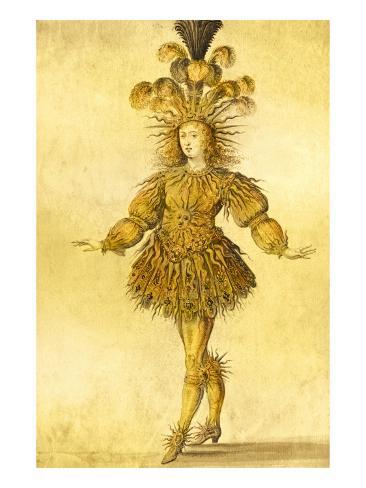

The contrasts between the excessive embellishments for King Louis’ Apollo and Balanchine’s much simpler version some 270 years later are interesting and speak to many developments in both ballet and human history. All of that is beyond the scope of this post, but watching Balanchine’s masterpiece, this amazing slice of ballet history in and of itself, is an awesome way to spend 30 minutes of quarantine life and I highly recommend it.
 Penny Askew